
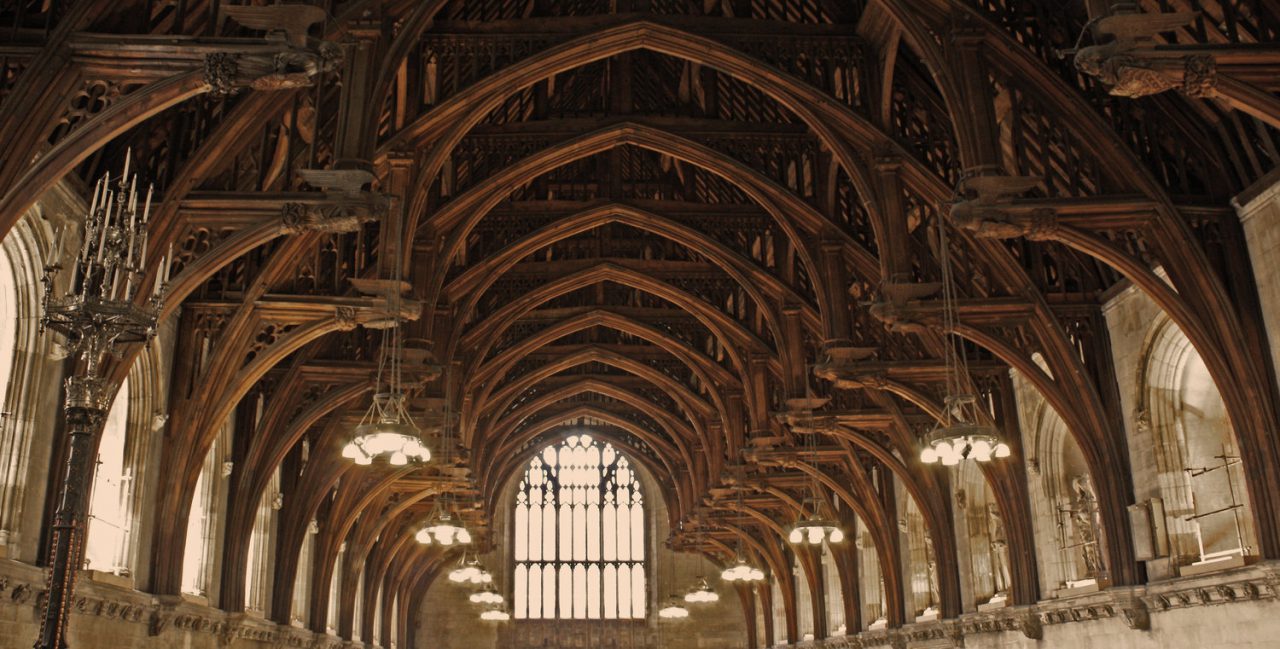
Let’s segue from the Princess Royal’s tour of China to what the Queen has been up to: Holyrood Week, or as it’s known in Scotland, “Royal Week.” Each summer, the Queen spends one week in residence at Holyrood Palace in Edinburgh, the primary residence of kings and queens of Scotland since the 16th century.
Month: July 2017
Princess Anne Tours China
I’m excited for this post, mainly because mentions of the Princess Royal have been few and far between on this site thus far. Usually she gets a brief mention here and there if she pops up at the same event as her brother or nephews, so I’m pleased to be able to cover some of her solo work.
If you haven’t heard, Princess Anne, only daughter of the Queen and the Duke of Edinburgh, is often referred to as the hardest working member of the Royal Family, and she’s earned her reputation the hard way. Last year she carried out 640 engagements, besting every other member of the family by a long-shot.
Isabella, the Second English Holy Roman Empress

There have been two English Holy Roman Empresses in history. The first was the more famous one, Henry I’s daughter, Matilda, who would end up in a struggle for the English throne with her cousin, King Stephen, during the Anarchy (1135-1154). And then there was Princess Isabella, daughter of King John and younger sister of Henry III.
Isabella had the great misfortune of being born the daughter of one of the worst kings of England and, in my opinion, one of the least sympathetic women of the Middle Ages, Isabella of Angouleme. Their marriage was ill-advised from the get-go, though the future Empress, born at the tail end of her father’s life, in 1214, missed most of the drama. She joined two older brothers, Henry and Richard, in the royal nursery, as well as a sister, Joan. The following year, as their father was forced to sign the Magna Carta, a final child, Eleanor, was born.
Continue reading “Isabella, the Second English Holy Roman Empress”
The Crowning of Richard III & Anne Neville
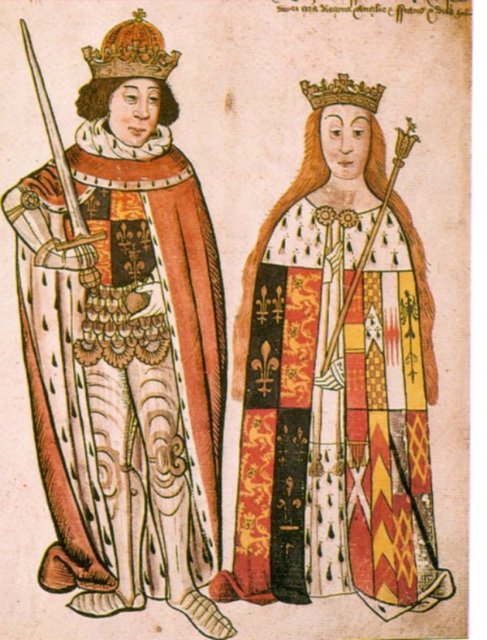
Today marks the 534th anniversary of Richard III’s coronation, an event that stands out from his reign as a moment of near-optimism. It was also an unusual ceremony in that it was a double crowning – Richard and his wife, Anne Neville, were anointed side-by-side in Westminster Abbey. The 12th century had seen the same with Henry II and Eleanor of Aquitaine, while the 13th century had seen Edward I and Eleanor of Castile and the 14th their son, Edward II, and his wife, Isabelle of France. That last coronation had taken place in 1308, 175 years before.
Continue reading “The Crowning of Richard III & Anne Neville”
The Ick Factor: Richard III & Elizabeth of York

Speaking of the Tudor Myth, a fun little twist to exanining Richard III is seeing two wildly divergent schools of thought on him. While there are presumably some objective histories of his life and reign, most fall into two camps: those that revile him and those that apologize for him.
This is particularly evident in the question as to whether or not Richard III made plans to marry his niece, Elizabeth of York, in 1485. What exactly the nature of their relationship was has been eroded by time, but there is far too much smoke around the issue for there not to have been at least a reasonably-sized fire. In this case, the theory is borne out by the fact that there was contemporary speculation on the subject, as well as the fact that Richard took the pains to publicly deny it.
Continue reading “The Ick Factor: Richard III & Elizabeth of York”
The Tudor Myth

Let’s start at the beginning: What is the “Tudor Myth”? Essentially, it’s a school of thought that the study of the Tudors and their immediate predecessors has been warped by Tudor propaganda. At its root, it’s a more specific way of saying, “History is written by winners.” The two Tudors considered most guilty of this whitewashing, if you will, are Elizabeth I and her grandfather, Henry VII, albeit for slightly different reasons.
Charles & Camilla Mark Canada’s 150th
To all my Canadian readers, apologies that this post is somewhat delayed. I decided to capture the recent visit of the Prince of Wales and Duchess of Cornwall for Canada Day in a single post as opposed to a day-by-day, but as a result we lost the chance to mark the occasion on July 1st. So, Happy Canada Day and congratulations on the big 150.
Just a Girl & Her Tennis: Kate at Wimbledon

Holy haircut, the Duchess of Cambridge is starting off July with quite the bang. But before we get there, let’s start with the tennis. Today, Kate appeared at the Wimbledon Championships for the first time in her capacity as royal patron of the All England Lawn Tennis & Croquet Club, a role she has taken over from the Queen and whose annual duties were carried out by the Queen’s cousin, the Duke of Kent.
Continue reading “Just a Girl & Her Tennis: Kate at Wimbledon”
Pettiness & Politics: The Early Years of Charles I & Henrietta Maria

For all that Charles I’s reign ended with his execution and his wife, Henrietta Maria of France, spent the next decade plus in exile, their relationship stands as one of the happiest examples of an arranged marriage in royal history. It did not, however, start out that way.
When the couple married in 1625 Charles was 24 and had only been sitting on the throne for a little over a month. Henrietta Maria was just 15, the younger sister of King Louis XIII of France and the pet of the Bourbon family. The most striking difference between them from the get-go was not age, but religion. England was not only avidly Protestant, but deeply suspicious of both Catholics and foreigners. The last time the English had had a Catholic consort was King Philip II of Spain during the reign of Mary I, a period of time marked by the burning of 300 Protestants and a campaign to return England into the folds of Rome. Needless to say, there was little interest in history repeating itself.
Continue reading “Pettiness & Politics: The Early Years of Charles I & Henrietta Maria”
The Afterlife of Diana, Princess of Wales

If you’re wondering what the Duke of Cambridge and Prince Harry are up to today, they’re at Althorp in Northamptonshire, the burial site and childhood home of their late mother, Diana, Princess of Wales. On what would have been her 56th birthday, the Archbishop of Canterbury is conducting a private re-dedication of her grave for her family, including her two sons, the Duchess of Cambridge, Prince George and Princess Charlotte. Diana’s brother, Earl Spencer, is apparently also in attendance, as are, presumably, other members of the Spencer family.
Continue reading “The Afterlife of Diana, Princess of Wales”